
Solid-Phase Peptide Synthesis (SPPS) represents the cornerstone of modern synthetic peptide production. Developed to enable efficient, step-by-step assembly of complex amino acid sequences, SPPS utilizes an insoluble polymeric resin support upon which amino acids are sequentially coupled from C-terminus to N-terminus. Understanding the underlying chemistry and physical steps involved in SPPS provides essential insight into peptide purity profiles and the origin of synthesis side-products.
1. Resin Selection and Initial Functionalization
The synthesis process begins with an insoluble solid support—typically a polystyrene or polyacrylamide resin matrix functionalized with specialized linkers (such as Wang or Rink Amide linkers). The choice of linker determines the C-terminal functional group of the final peptide upon cleavage, producing either a C-terminal free carboxylic acid (COOH) or a C-terminal amide (CONH2).
Before chain elongation begins, the resin undergoes swelling in organic solvents (e.g., N,N-Dimethylformamide or DMF) to ensure optimal reagent accessibility to reactive functional sites embedded within the polymer matrix.
2. The Iterative Synthesis Cycle
Chain assembly proceeds through a repeating sequence of chemical operations for each added amino acid:
-
Deprotection: The temporary protecting group (commonly 9-Fluorenylmethoxycarbonyl or Fmoc) shielding the N-terminus of the resin-bound amino acid is removed using a mild base solution (e.g., 20% piperidine in DMF). This exposes a reactive primary amine.
-
Washing: The resin matrix is thoroughly washed with DMF to remove excess base and deprotection byproducts, preventing premature reaction in subsequent steps.
-
Coupling: The next incoming amino acid—protected at its N-terminus and side chains—is introduced alongside a coupling reagent (such as HATU, HBTU, or DIC/Oxyma). This converts the carboxylic acid into an activated ester, enabling rapid peptide bond formation with the exposed resin-bound amine.
-
Capping (Optional): If a coupling reaction is incomplete, an acetylating reagent (e.g., acetic anhydride) is introduced to permanently block unreacted amines, preventing the formation of deletion sequences that closely mimic the full-length target sequence.
3. Cleavage and Side-Chain Deprotection
Once the desired sequence length is achieved, the fully assembled, resin-bound peptide undergoes a final chemical cleavage step. This is typically performed using a strong cleavage cocktail containing Trifluoroacetic Acid (TFA) alongside specialized chemical scavengers (e.g., triisopropylsilane, water, and ethanedithiol).
This dual-action reaction simultaneously:
-
Cleaves the covalent bond linking the C-terminus to the resin support.
-
Removes permanent protecting groups (such as t-Bu, Pbf, or Trt) attached to reactive amino acid side chains (e.g., Lys, Arg, Cys, Asp).
4. Post-Synthesis Purification and Lyophilization
The crude material liberated from the resin contains the target peptide alongside truncated impurities, protecting group remnants, and residual cleavage reagents. To yield high-purity research materials, the crude mixture undergoes preparative Reverse-Phase High-Performance Liquid Chromatography (RP-HPLC).
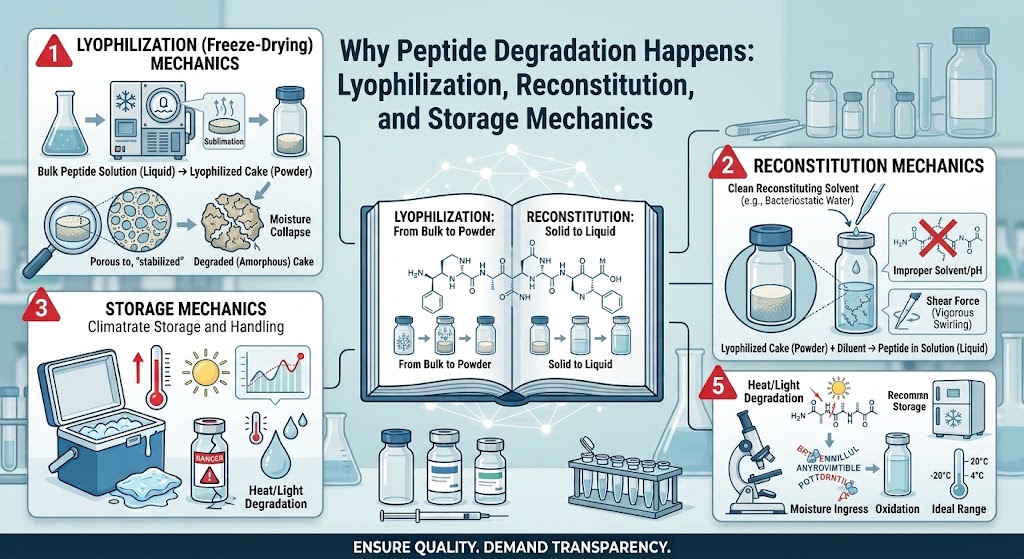
Following chromatographic separation and fractions collection, pure fractions are frozen and subjected to lyophilization (freeze-drying) under high vacuum. This removes residual aqueous solvent, yielding a stable, amorphous powder cake ready for analytical characterization.
Summary Guidelines for SPPS Compound Quality
-
Coupling Efficiency: Automated UV monitoring during deprotection steps provides real-time verification of coupling completion across difficult or hydrophobic sequences.
-
Sequence Integrity: Proper side-chain protection and optimized cleavage protocols prevent unwanted side reactions, such as cysteine oxidation or aspartic acid rearrangement.
-
Purification Verification: Post-cleavage preparative HPLC ensures the removal of deletion peptides prior to final lot release.
At Axova Research, our production workflows combine optimized solid-phase synthesis protocols with rigorous multi-step purification to deliver research compounds exceeding stringent purity standards.